Asking ‘at what height is scaffolding required in NZ’ is the smartest first step for any exterior project. With December deadlines arriving, the summer rush to finish painting or roof repairs is intense. It is tempting to grab a ladder to save time, but that “easy fix” often leads to disaster. Gravity doesn't care about your schedule or your budget. A quick job can turn into a life-changing fall or a crushing WorkSafe fine in a split second.
Remember, these regulations apply to everyone, not just commercial sites. Ignoring the rules isn't brave, but a massive risk to your wallet and your health. Before you start climbing, you need to know exactly when a professional platform is the only safe option.
The "Golden Rules" of NZ Scaffolding Heights
The construction industry in New Zealand is strictly regulated for a very good reason. Falls from height are one of the biggest causes of serious injury and death on work sites. Because of this, WorkSafe has set clear boundaries.
However, there is often a lot of confusion about at what height scaffolding is required in NZ because people mix up two different rules. You need to separate the fall protection rule from the rule on who can build the scaffold.
These are the "Golden Rules" of scaffolding heights that dictate what you can and cannot do:
The 3-Metre Rule (Fall Protection)
This rule focuses solely on fall risk management. If you are asking what height you need to use scaffolding for personal safety, this is the critical regulation. It is important to understand the distinction: you can technically work on a scaffold under 5 metres without holding a "ticket" or licence, but that does not mean you can ignore safety.
Regulation 21 of the Health and Safety at Work Regulations states clearly that if there is a risk of a fall of 3 metres or more, you must have suitable fall protection in place.
The Legal Requirement
If you are working at this height, you must use effective measures to prevent a fall. This usually means installing guardrails, edge protection, or a full scaffold. You cannot simply balance on a ladder or a plank.
Why Regulation 21 Matters?
This rule exists because a fall from 3 metres can cause severe injury or death. Even if you are building the scaffold yourself (which is legal up to 5 metres), it must be built to a standard that prevents you from falling off. If you cannot provide that protection, you should not be up there.
Suitable Protection
"Suitable" means the protection acts as a physical barrier. A harness system can count, but a fixed scaffold with rails is always preferred because it protects everyone on the platform without requiring active user input.
The 5-Metre Rule (Certified Scaffolder Required)
At what height is scaffolding required in NZ to be built by a certified professional? Five metres is the strict cutoff point. This rule concerns the structure itself and determines who is legally allowed to assemble the equipment. If the highest working platform of your scaffolding is 5 metres or more above the ground, it is illegal to erect, alter, or dismantle it yourself unless you hold a relevant Certificate of Competence (CoC).
The Certificate of Competence
Building a scaffold higher than 5 metres needs specialist knowledge. This specific threshold dictates exactly at what height scaffolding is required in NZ to be managed by a certified professional. A certified scaffolder understands load weights, live loads, and wind ratings. They know how to calculate the structural integrity of the base. If you do not have this ticket, you cannot touch the structure.
Mandatory Notification
Any scaffold where a person can fall 5 metres or more is considered "notifiable work." This means you must notify WorkSafe at least 24 hours before the work begins. This gives inspectors the chance to review the site plan and ensure everything is up to code.
The Danger of DIY
We see people trying to extend mobile towers beyond their limits to save money, but this is incredibly dangerous. As you go higher, the physics of the structure changes. The wind pressure increases, and the stability decreases. At this stage, you need a partner who understands these forces inside out. This is where King Kong Scaffold steps in to guarantee the structure will stand up to the elements.
High-Rise Projects: Why "Good Practice" Beats Minimum Compliance
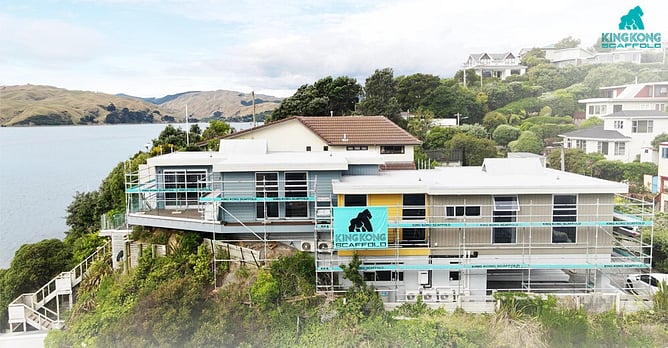
Wellington is defined by its hills, not flat ground. Most projects we tackle sit on slopes or tricky edges. You might see a standard two-story house, but if it sits on a hill in the suburbs, it behaves like a high-rise.
A wall might be low on one side, but the ground often drops away steeply on the other. This creates a "virtual" height much taller than the building itself. In these spots, asking at what height scaffolding is required in NZ is about good practice, not just minimum rules.
The Slope Factor. If you set up a retaining wall, you must account for the drop below. A 2-metre fall to a deck that is 4 metres above the road is a total fall of 6 metres. You must treat this as a high-risk zone.
Wellington Wind. Our region is famous for wind. A standard scaffold might not survive a strong Southerly. We over-engineer our bracing because we know how aggressive the weather gets here.
Good Practice Guidelines Scaffolding Standards
To ensure we deliver the safest possible result, we adhere to the strict standards set by Scaffolding, Access and Rigging New Zealand (SARNZ). While many people focus solely on determining the height of scaffolding required in NZ, these guidelines go beyond the basic requirements of the Health and Safety at Work Act.
Following good practice guidelines for scaffolding protocols ensures that every single component of the build is safe and secure.
Sole Boards and Base Plates. We never place a scaffold leg directly onto bare ground or grass. The good practice guidelines for scaffolding mandate the use of sole boards (timber planks) under the base plates. This spreads the structure's weight over a larger area. It prevents the scaffold from sinking into the mud when it rains, which would cause the tower to lean or collapse.
Safe Access Points. Climbing up the outside of a scaffold frame is a major safety violation. Good practice demands internal access. We install proper ladders inside the bays and use hatch platforms. This allows workers to climb up safely without hanging off the side of the structure.
Correct Bracing. A scaffold is only as strong as its bracing. Diagonal braces prevent the structure from twisting or swaying. We follow the manufacturer's strict specifications for bracing patterns. This is critical for keeping the platform rigid, especially when multiple tradespeople are working on it at once.
Scaffolding Stability: What is the 3:1 Rule for Scaffolding?
Stability is a matter of physics. If a scaffold is too tall and too narrow, it will fall over. This is a common issue with free-standing towers that are not tied to a building. Understanding at what height scaffolding is required in NZ also helps you understand the geometry of the equipment you are using.
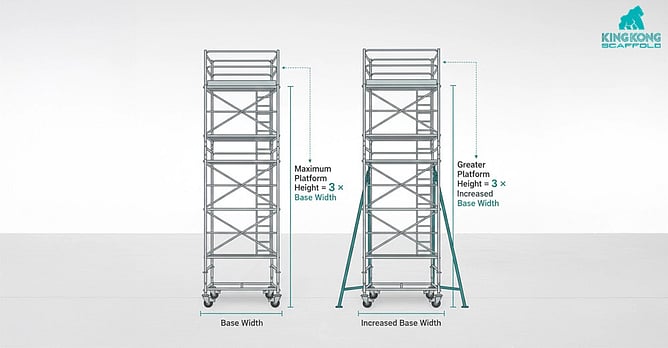
To keep structures safe, you must follow a specific ratio. The 3:1 rule for scaffolding states that for a free-standing scaffold, the working platform height must not exceed 3 times the minimum base width.
The Calculation in Practice. If you are using a standard mobile scaffold that is 1.2 metres wide at the bottom, the maximum height you can set the platform to is 3.6 metres. If you want to go higher than that, you'll need to increase the base's width. You can do this by adding outriggers to the bottom.
Why It Matters. This ratio is critical in outdoor settings. The wind acts as a force against the side of the scaffold. If the base is too narrow, the wind can act as a lever, tipping the whole tower over. Even a small gust can be dangerous if the ratio is ignored.
Indoor vs Outdoor. While some guidelines allow a 3.5:1 ratio indoors with no wind, we stick to the 3:1 rule as a standard for maximum safety. It is always better to be wider and more stable than to push the limits.
Why Mobile Scaffolds Are Not Always the Answer
When homeowners start researching ' at what height is scaffolding required in NZ’, they often look for the cheapest option first. This usually leads them to mobile aluminium towers.
The "Hardware Store" Mentality vs. Professional Service
Adopting the "hardware store mentality" often means renting a mobile tower to save on costs, but this rarely matches the efficiency of a professional service. You have probably seen these units at your local hire shop. While they are excellent for flat, indoor surfaces, painting the outside of a house with a mobile tower is often frustrating and inefficient.
Uneven Ground Issues. Mobile towers rely on wheels that need a hard, flat surface to roll on. Most residential properties in NZ have grass, garden beds, or sloped concrete paths around the perimeter. You cannot safely roll a mobile tower over grass. This means you have to dismantle it and rebuild it every time you move it, which wastes hours of your time.
The Reach Gap. Because mobile towers are square or rectangular, they struggle to fit around obstacles. If you have a bay window, a chimney, or a porch, you cannot get the tower close enough to the wall. This leaves a dangerous gap. You end up leaning over the rail to reach the paintwork, which defeats the purpose of the safety gear.
Efficiency and Speed. With a fixed Ringlock scaffold system, we build a continuous walkway around your house. You can walk from the front door to the back door without stopping. You can have multiple people working at the same time. The job gets done in half the time because you are not constantly fighting with the equipment.
The Pivot to Professional Standard. While mobile towers have their place, "high-rise" exterior work such as full-house painting or roofing requires a different approach. This is where professional service wins. We use fixed Ringlock scaffolding because it is safer and provides the full edge protection required by law. Unlike a mobile tower, a fixed system creates a continuous walkway around your home, allowing you to work efficiently without constantly fighting the equipment.
Make Safety Your Top Priority
Navigating the 3-metre fall protection and 5-metre certification rules can be confusing, but you don't have to face it alone. Knowing exactly at what height scaffolding is required in NZ is critical to avoiding fines and injuries.
Unsure if your site meets the criteria? Send us a photo. King Kong Scaffold offers a quick compliance check to tell you exactly what you need. We specialise in Ring-lock scaffold hire, from full house wraps to mobile towers, so you never have to guess. Contact us for a compliant quote today.
Frequently Asked Questions
Can I put up my own scaffolding?
You are allowed to put up your own scaffolding only if the highest platform is under 5 metres. However, you must be competent to do so. You need to understand the manufacturer's instructions for bracing and stability. If the potential fall is 5 metres or more, it is illegal to do it yourself. You must hire a certified scaffolder with a CoC.
At what height is fall protection required in NZ?
WorkSafe regulations state that fall protection is required when there is a risk of a fall of 3 metres or more. However, safety regulations don't ignore shorter drops. While 3 metres is the specific threshold for mandatory controls, WorkSafe requires you to take "reasonably practicable" steps to prevent harm from any height, even 1-2 metres. If the area below the work is hazardous, such as concrete or sharp objects, fall protection is essential regardless of the distance.
What are the guidelines for scaffolding in Worksafe?
WorkSafe NZ relies on the good practice guidelines for scaffolding in New Zealand. These guidelines outline the standards for erecting, dismantling, and using scaffolding safely. They cover load ratings, bracing patterns, and training requirements. Following good practice guidelines ensures compliance with the Health and Safety at Work Act.

